
Where should you hit, and where should you avoid hitting?
Written by: Mistress Moriah
Where can you strike, and where should you avoid striking? Safe impact play begins with knowledge of the body.
Impact play can be intense, bonding, and deeply relaxing, but only when performed with anatomical knowledge and respect for the physical limits of the body. Striking is not a random act. Under the skin lie muscles, nerve pathways, organs, and bone structures that all respond differently to force, direction, and type of strike. Those who want to play responsibly need to know where the body can absorb impact and where it is vulnerable.
This overview divides the body into four practical zones: green, yellow, orange, and red. This classification is used internationally in BDSM education and helps to limit risks.
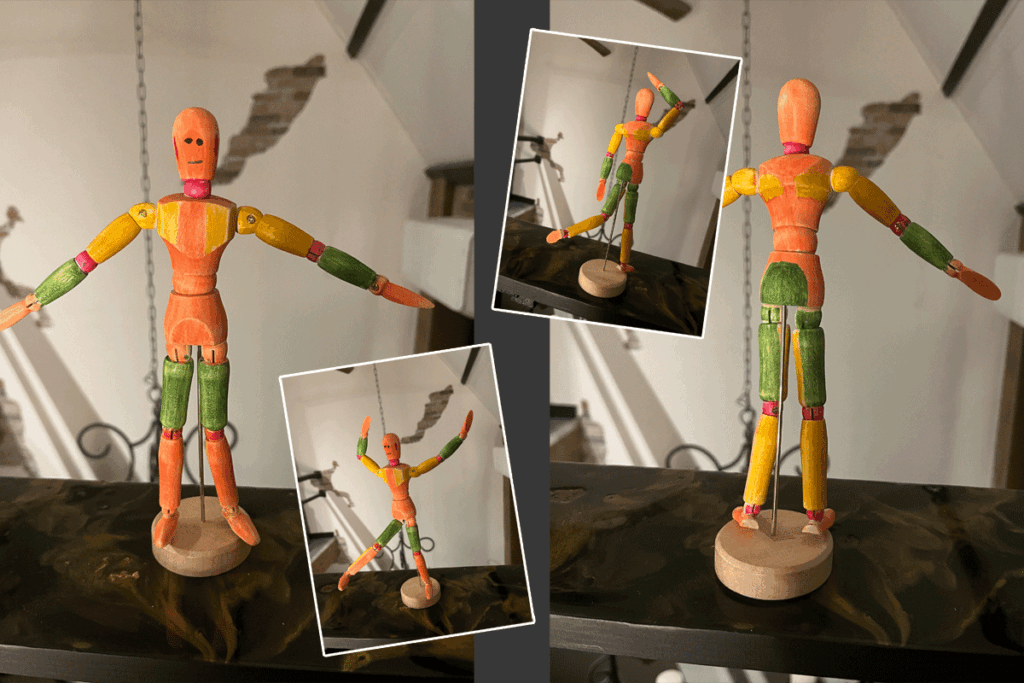
Green zones – Here you can strike firmly and safely
The green zones are parts of the body with sufficient muscle mass to absorb impact without damaging vital structures.
These are the safest places:
- The buttocks (gluteal muscles)
- The back of the upper legs
- The fleshy part of the upper back (trapezius, not the spine)
Why these zones are safe:
These areas consist of thick layers of muscle that cushion blows before they reach deeper structures. There are few vulnerable organs and the body is biomechanically designed to absorb force in these areas. That is why these zones are traditionally used for spanking, flogging, and heavier impact.
Risks remain, of course, with extreme force or repeated strikes in exactly the same spot, but in a controlled form, these are the most forgiving areas.
Yellow zones – Possible, but with control and experience
These zones can withstand impact, but require accuracy and dosage.
These are:
- The side of the buttocks and hips
- The outside of the thighs
- The shoulders (muscle area, not the joint)
- Upper arms (but not with the cane)
Why caution is needed:
Important nerve pathways are closer to the surface here, such as the sciatic nerve on the outside of the leg. Incorrectly placed blows can cause tingling, nerve pain, or prolonged sensitivity. The muscle mass here is also less homogeneous, which means that force is distributed unevenly.
Preferably use wider impact toys here and avoid sharp, concentrated impact.
Orange zones – Only lightly and with a lot of knowledge
These are areas where anatomical structures become vulnerable.
These include:
- The lower back (kidney area)
- The inside of the thighs
- The area near the spine
- Forearms
Why these areas are risky:
The kidneys are relatively unprotected and can be damaged by direct impact. Unlike muscles, organs cannot absorb blows. Damage is not always immediately visible but can be medically serious. The inner thigh contains blood vessels and nerve structures that are sensitive to bruising.
The forearm does contain muscle mass, but that muscle layer is relatively thin. Directly underneath it are the bones (radius and ulna), tendons that control the hand and fingers, nerve pathways such as the ulnar nerve and median nerve, and blood vessels. There is little “cushioning.” A hard blow quickly reaches bone or nerve.
Hard impacts do not belong in these areas.
Red zones – Never strike here
From a medical point of view, these zones are absolutely unsuitable for impact play.
Never strike:
- The neck
- The head
- The spine itself
- The abdomen and ribs
- The kidneys
- Joints
- Knee pits
- Armpits
Why this is off-limits:
These areas contain vital organs, arteries, the spinal cord, and structures that cannot recover from blunt trauma. Even a relatively light blow can cause nerve damage, internal bleeding, or permanent injury. Within safe BDSM practice, these are not “borderline areas” but clear off-limits zones.
What is the difference between impact toys?
Not every strike works the same way. The shape, mass, and speed determine how deep the impact penetrates.
Flogger
A flogger distributes the force across multiple strands. This creates a more superficial, “diffuse” impact. The effect remains largely in the skin layer and stimulates blood flow without deep bruising. Ideal for warming up and prolonged play.
Paddle
A paddle delivers a flat, solid blow. The force is distributed more widely than with a cane, but penetrates deeper than a flogger. This affects both the skin and underlying muscle and can cause severe bruising.
Cane
A cane concentrates all energy in a narrow line. This creates high pressure on a small surface area. This causes deep tissue impact and increases the risk of damage if used incorrectly. Canes require precision and experience.
Single tail
The single tail creates speed and sharp, cutting energy. The impact is very localized and can cause both superficial welts and deep trauma. This instrument should only be used by technically skilled players.
Wooden slat or linear striking tool
A hard slat has little flexibility and does not absorb energy. The blow is transferred directly to the body. This makes it biomechanically heavier than is often thought.
What happens in the skin and underlying tissues?
Impact causes microtrauma. That sounds negative, but when controlled, it causes:
- Increased blood flow
- Endorphin release
- Muscle relaxation
- Adrenaline response
The difference between “safe” and “harmful” lies in the depth of the trauma.
Superficial impact mainly affects the dermis (skin layer).
Deep impact reaches muscle tissue and can cause hematomas.
Impact that is too deep can affect organs or nerves, and that is something you want to avoid.
Which toys cause permanent welts?
Visible marks are related to pressure distribution.
Toys that more often cause long-lasting marks:
- Cane
- Single tail
- Narrow paddles
- Hard linear striking tools
Toys that usually cause milder, faster-disappearing marks:
Bruises occur when blood vessels rupture locally. This is not a goal in itself but a possible consequence. Those who want to play discreetly will therefore choose different instruments than those who accept visible marks.
Safety is not a limitation but a skill
Impact play is not a matter of hitting harder, but of understanding how force travels through the body. The difference between a safe session and injury is rarely a matter of intention, but almost always a matter of anatomical knowledge and use of materials.
Respect for zones, choice of instrument, and dosage of force make the difference between damage and an intense but responsible experience.
Those who strike without knowledge use violence.
Those who strike with knowledge use technique.
Mistress Moriah
More information
More inspiring blogs by Mistress Moriah
