
Hoist
Definition
A hoist is a mechanical lifting system used in BDSM to raise, lower, or position a body or limbs in a controlled manner. A hoist can be operated manually or electrically and is designed exclusively to carry weight safely and stably.
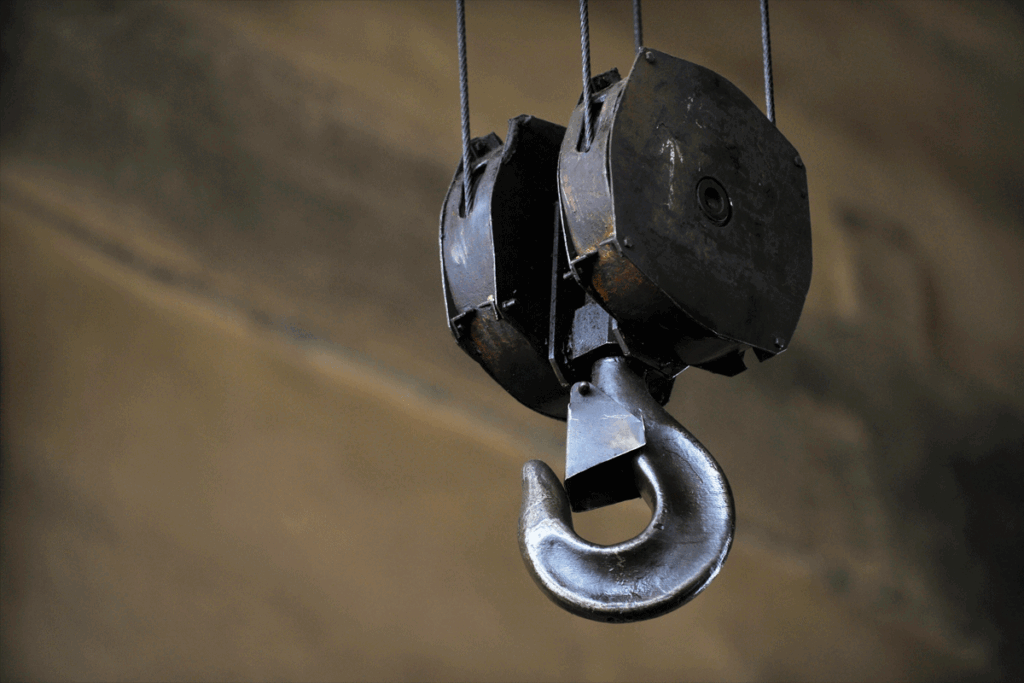
Explanation of a hoist
In BDSM, a hoist is used for bondage, suspension, or controlled movement of a sub. Although it looks simple, it is one of the most complex and risky pieces of equipment in a BDSM room. A hoist not only carries the static weight of the sub, but also the moving weight. This means that any form of swinging, turning, pulling, or sudden movement increases the load on the system. That is why hoists are only suitable when working with professional equipment specifically designed to safely carry people – or heavy weights.
A hardware store hoist or a system intended for tools or bicycles is absolutely unsuitable. Commercial studios therefore work with certified hoists, often with clear weight indications and inspections that demonstrate that the system can handle the required capacity.
The advantage of an approved hoist is that you know exactly what the margins are, how much reserve capacity the system has, and how stable the movement is. For a Dominant, it allows them to build tension in a controlled manner, play with height differences, and put the sub in a position that would otherwise be physically impossible.
Safety and points of attention
The biggest mistake that is made is thinking that a hoist only has to carry the body weight. In reality, the capacity must be based on: body weight plus moving load plus safety margin.
An 80-kilogram sub can easily cause a load of 120 to 150 kilograms with a small swing or jerk. That is why a safety factor of at least 1:5 is standard for human carriers. This means that a hoist for an 80-kilogram sub should ideally be suitable for a load of 400 kilograms.
Electric hoists also have a working load limit (WLL) and a breaking load (MBL). Only the WLL counts for safety.
Never use hoists from the hobby sector, hardware stores, or for decorative pieces. These have not been tested for human weight and can break unexpectedly.
The attachment point is also crucial. A hoist is only as safe as the beam, ring, or anchor to which it is attached. A mistake here can be life-threatening. Therefore, always check: ceiling construction, load capacity, fastening materials, and wear and tear.
Furthermore, it is essential that the sub is not left unattended in a hoist. Even light suspension can cause circulation problems, numbness, or dizziness.
The Dominant must be present at all times, paying attention to breathing, color, reaction, and comfort. Finally, a hoist must be inspected regularly or replaced as soon as there are signs of wear.
Related terms hoist
Bondage
Suspension
More information
